.svg)
M-CHAT-R autism screening test
The Modified Checklist for Autism in Toddlers, Revised (M-CHAT-R) is the most widely used screening tool to identify early risks of autism. Learn how this simple questionnaire works and why it is a vital first step for monitoring your child's development.
Start EvaluationHow the M-CHAT-R screener works
Overview
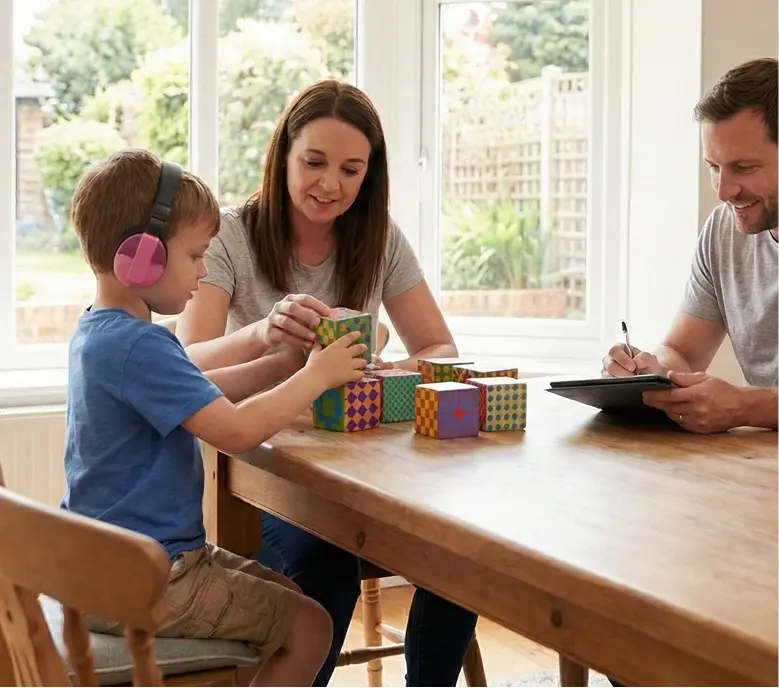
The M-CHAT-R is a "parent-report" screening tool, meaning it relies on your observations of your child’s daily behavior. It consists of 20 simple Yes/No questions designed specifically for toddlers between 16 and 30 months of age. Its goal is not to diagnose, but to flag if a deeper evaluation is needed.
.webp)
How long does the M-CHAT-R take?
It is designed to be quick and accessible. Most parents can complete it in less than 10 minutes. It can be done during a pediatric check-up or comfortably at home. The key is to answer based on how your child usually behaves, not just on their best or worst days.
What do the M-CHAT-R questions focus on?
The questions assess social engagement and communication skills rather than physical milestones (like walking). It focuses on "Joint Attention" and interaction.
Key Metrics:
- Joint Attention: Does your child point to show you things?
- Imitation: Do they copy you if you make a face?
- Response: Do they look up when you call their name?
- Social interest: Do they show interest in other children?
.webp)
No wait list

In-Home Support

Online Support

Professional Plans
.svg)
No wait list
In-Home Support
Online Support
Professional Plans
M-CHAT-R scoring
The checklist is scored by adding up responses that indicate developmental variations. Depending on the total points, the result is categorized into three risk levels.
How the M-CHAT scoring works
Each answer that indicates a potential risk counts as 1 point. The total score determines the recommended action. It is important to remember that a high score is not a diagnosis of autism, but a strong signal to seek a formal evaluation.
Score range
Interpretation
Recommended action
0-2
Low risk
Continue routine developmental monitoring.
3-7
Medium risk
A follow-up interview is needed to clarify answers.
8-20
High risk
Immediate referral for a diagnostic evaluation (ADOS-2) is recommended.
What happens after the M-CHAT-R?
After completing the M-CHAT-R, one of our Clinic Admissions Associates (CAAs) will review your child's responses. You'll typically be contacted within one business day to discuss the results and recommended next steps.
Low Score
- Indicates that the child is developing social skills expected for their age.
- No immediate action required.
- Continue with standard pediatric check-ups.
.svg)
.svg)
Medium score
- Indicates potential delays in specific areas.
- Providers usually conduct a "Follow-Up Interview" to confirm if the questions were understood correctly.
- If the score remains elevated, a referral is made.
High score
- Indicates a high probability of developmental challenges or autism.
- Do not wait to see if they "grow out of it."
- Schedule a formal diagnostic evaluation (ADOS-2) and contact Early Intervention immediately.
.svg)
Get started within 48hrs.
No need to wait! Get a schedule ready in 1 to 2 weeks.
Autism screening tools
for children by age
The CAST / AQ-Child
For Children (4–11 Years)
An overview of the tools used to screen social and communication behaviors in school-aged kids.
The ADOS-2
For All Ages (Toddlers to Adults)
Not a quiz, but a clinical test. Learn how this comprehensive schedule leads to a formal diagnosis.
FAQs
We understand that the diagnostic process can be overwhelming, and you likely have many questions about what to expect. To help you feel prepared and confident, we have compiled answers to the most common inquiries regarding the ADOS-2 assessment, insurance coverage, and how our team supports you through the evaluation.
Can I use the M-CHAT-R for older children?
No. This tool is clinically validated only for toddlers aged 16 to 30 months. For older children (4–11 years), other tools like the CAST or SCQ are used.
Is the M-CHAT-R a medical diagnosis?
No. It is a screening tool. A result of "High Risk" means there are red flags that require investigation, but only a licensed psychologist or developmental pediatrician can provide a formal medical diagnosis of Autism Spectrum Disorder.
Can I do the test at home?
Yes, the questionnaire is public and designed for parents. However, we strongly recommend reviewing your results with a pediatrician or a specialist to ensure the responses are interpreted correctly before jumping to conclusions.
Reach Out Today
Learn more about how we can support your child’s growth and development. Contact us to discuss our services and availability in your area.