.svg)
Online CAST autism screening tool
The Childhood Autism Spectrum Test (CAST) is a widely recognized tool designed to identify autism spectrum traits in school-aged children (ages 4–11). Understanding your child's social and communication style is the first step toward getting them the right support.
If your child is younger than 4, please complete the M-CHAT-R screening tool instead of the CAST.
Start EvaluationHow the CAST works
Who completes the CAST?
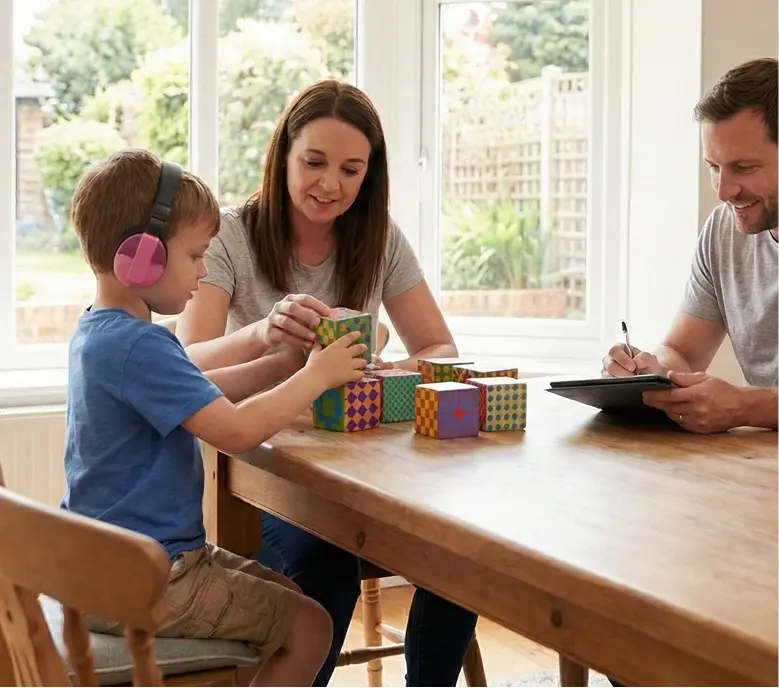
This is a parent-report questionnaire. As a parent, you know your child best. The survey asks about behaviors you observe in daily life—at the dinner table, during play, or when getting ready for school. You do not need a doctor present to fill it out.
.webp)
How long does the CAST take?
The assessment consists of 37 simple questions and typically takes about 15–20 minutes to complete. It can be done comfortably at home. There are no "right" or "wrong" answers—just honest observations about your child’s development and personality.
What does the CAST ask about?
While toddler tests look for basic interaction, the CAST focuses on more complex social skills and communication patterns common in school-aged children.
Key Metrics:
- Peer relationships: Do they find it easy to make friends?
- Conversation: Can they hold a two-way conversation?
- Flexibility: Do they become upset by minor changes in routine?
- Interests: Do they have highly specific or intense hobbies?
.webp)
No wait list

In-Home Support

Online Support

Professional Plans
.svg)
No wait list
In-Home Support
Online Support
Professional Plans
CAST scoring
The CAST system helps parents quantify their observations. It is not a medical test, but a way to measure the likelihood of autism spectrum traits based on scientific research.
CAST scoring method
The questionnaire contains 39 questions (37 scored items and 2 control questions). Each answer that matches the profile of autism spectrum traits scores 1 point. The maximum score is 31.
Score range
Interpretation
Recommended action
0-14
Low likelihod
Continue to monitor development. No immediate action required.
15-31
High likelihood
Significant possibility of autism. A formal diagnostic referral is strongly recommended.
Please note: This tool identifies traits associated with autism but cannot replace a clinical diagnosis by a healthcare professional.

What to expect after the CAST
Once you complete the Childhood Autism Spectrum Test, the team at Skill Builders will generate a report to guide you through the next stage of your journey. We are here to translate data into actionable care.
Our specialists analyze your responses to highlight specific areas of strength and concern, providing a clear summary of findings.
If your score suggests potential needs, we can schedule a full diagnostic evaluation (such as ADOS-2) to provide a formal diagnosis.
Based on the results, we create a tailored roadmap including therapy options (ABA, Speech, OT) and educational support strategies.
- Tailored therapy recommendations such as ABA, Speech, or Occupational Therapy.
- Guidance for educational settings, including tips for IEPs and classroom support.
- Actionable strategies for home to help build communication and daily life skills.
Autism screening tools
for children by age
The ADOS-2
For All Ages (Toddlers to Adults)
Not a quiz, but a clinical test. Learn how this comprehensive schedule leads to a formal diagnosis.
The M-CHAT-R
For Toddlers (16–30 Months)
The gold standard checklist for detecting early autism risk in toddlers. See how it works.
FAQs
We know that exploring neurodiversity can raise many questions. Here are answers to common inquiries parents have about the screening process.
Is the CAST a formal medical diagnosis?
No. The CAST is a preliminary screening tool, not a diagnostic test. It is designed to identify traits associated with autism spectrum conditions. A high score indicates a need for further assessment but does not replace a comprehensive evaluation by a specialist.
What should I do if my child receives a high score?
If your child scores above the threshold (typically 15+), it suggests a higher likelihood of autism. We recommend sharing the detailed report with your pediatrician or contacting us to schedule a full diagnostic evaluation to investigate further.
Can I use the CAST for children under 4 years old?
The CAST is clinically validated specifically for children aged 4 to 11. For toddlers (ages 16–30 months), we recommend using the M-CHAT-R/F screener, which is better suited to early developmental milestones.
Can I share these results with my child's school?
Yes. The results provide a helpful summary of your child's social and communication patterns. While it is not a diagnosis, it can be a useful tool to start a conversation with teachers or SEN (Special Educational Needs) coordinators about support.
Reach Out Today
Learn more about how we can support your child’s growth and development. Contact us to discuss our services and availability in your area.